


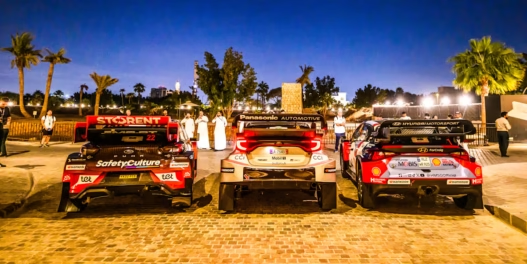
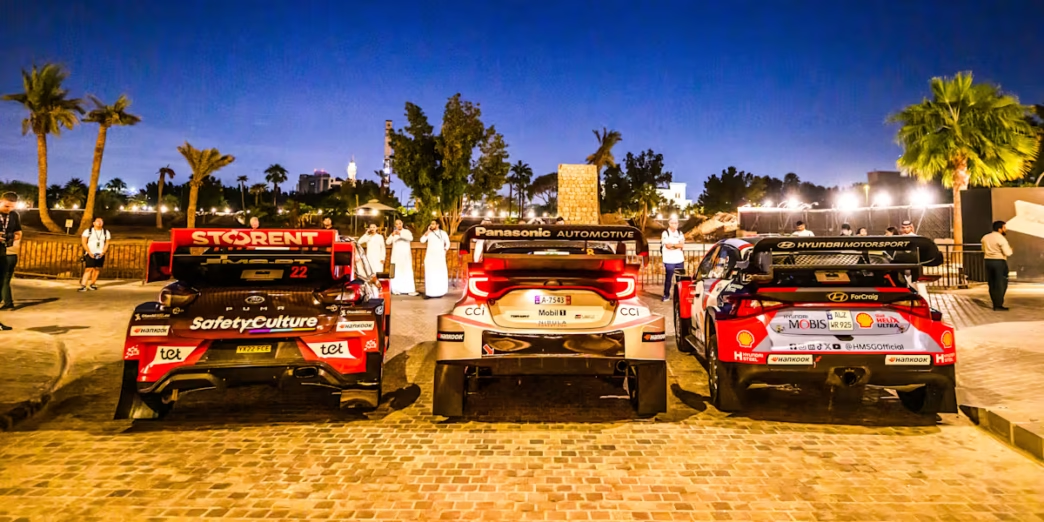
- The 2025 Rally Saudi Arabia was the first time the WRC ended its season in Saudi Arabia — a brand-new rally added to the calendar.
- The rally served as the final round (Round 14) of the 2025 2025 FIA World Rally Championship season — deciding both the drivers’ world title and the annual standings.
- The course comprised 17 special stages over a competitive distance of 319.44 km.
- The terrain was especially demanding: the rally combined soft and sandy desert tracks, rocky and rough mountain roads, and was under high-temperature conditions. This mix proved a severe test for cars, tyres and crews.
So — a first-ever Saudi finale, tough desert/mountain terrain, high stakes: ideal for drama.
Key Results: Who Won & Who Took the Title
- The rally itself was won by Thierry Neuville / Martijn Wydaeghe (driving a Hyundai i20 N Rally1).
- 2nd place went to Adrien Fourmaux / Alex Coria (also Hyundai), though their final result was affected by a one-minute time penalty for an early check-in — meaning they lost the lead they had on Friday evening.
- 3rd place — and the result that decided the title — went to Sébastien Ogier / Vincent Landais (Toyota GR Yaris Rally1). Their finish secured them the 2025 drivers’/co-drivers’ world championships.
- Behind them: 4th was Sami Pajari, 5th Takamoto Katsuta, 6th Elfyn Evans, and 7th Kalle Rovanperä (among others).
Other category winners: in the lower-tier classes, Gus Greensmith / Jonas Andersson won WRC2; Matteo Fontana / Alessandro Arnaboldi won WRC3; and Nikolay Gryazin / Konstantin Aleksandrov secured the WRC2 Challenger title.
How the Championship Was Decided — Drama, Strategy & Turning Points
This final rally became not just about winning the event — but about the title. Several factors made the 2025 season finale dramatic:
- Coming into the rally, Ogier and his teammate Elfyn Evans (Toyota) — plus other contenders — were all mathematically capable of taking the championship.
- On the final day: Ogier started just one position ahead of Evans and held only a small provisional advantage (2 points) in the standings.
- On the penultimate stage — the long “Asfan” test — Ogier delivered a decisive push. He climbed from sixth to third overall, a crucial leap given issues suffered by others (punctures, crashes, wheel changes).
- Notably: the previous overnight leader (Mārtiņš Sesks) and competitor Kalle Rovanperä both stopped to change wheels; another contender rolled his car.
- With that move, Ogier put himself in position to secure the title. On the final “Power Stage” (Wolf Power Stage / Thahban 2), he delivered a measured run — enough to seal the championship.
As a result, Ogier clinched his ninth world championship; his co-driver Vincent Landais earned his first.
🏆 Significance: What This Means for the Drivers, Teams & WRC History
- With this 2025 title, Sébastien Ogier draws level with Sébastien Loeb — each with 9 WRC world championships. That ties the all-time record.
- For Landais — his co-driver — this is his first WRC world co-driver title.
- For the team side: the season-ending rally confirmed the dominance of Toyota Gazoo Racing World Rally Team (TGR-WRT). The manufacturers’ championship — already secured earlier — adds to their legacy.
- For the WRC itself: the successful debut of Rally Saudi Arabia as a finale shows the championship’s expansion and willingness to test crews in harsh desert & mountain terrain — unlike many of the classic European rallies. It adds a new flavour to WRC.
Also — for Neuville and his team (Hyundai Shell Mobis World Rally Team) — the rally win represents a strong finish for the season, even though they missed out on the world title. It will be a morale boost and an important highlight of 2025.
📅 What’s Next: Looking Ahead to WRC 2026 (After Saudi Arabia 2025)
- The 2025 WRC season is now over. According to reports, Ogier has already committed to about 10 rally starts in 2026 — though he downplayed talk of chasing a 10th world title.
- The performance in Saudi Arabia — the added challenge of desert/mountain terrain — may encourage organizers and WRC promoters to include more “non-traditional” rallies in future seasons, depending on feedback and logistics.
- For other drivers and teams (Hyundai, M-Sport, younger talents) the result offers motivation. A close but dramatic finish shows that reliability, strategy, and endurance remain as important as outright speed.
🔎 Additional Context & Observations
- The final day “sweep up”: Several drivers — including those who had looked strong — fell victim to punctures, wheel changes, or crashes. That opened the window for Ogier to capitalize. Shows how unforgiving WRC can be, especially on abrasive desert/mountain terrain.
- It’s remarkable that despite competing only part-time in 2025 (skipping three rallies), Ogier still clinched the championship — underlining his consistency, experience and ability to perform under pressure.
- The inaugural Saudi finale may mark a shift: WRC exploring more diverse geographies, perhaps increasing global appeal beyond traditional stages.


